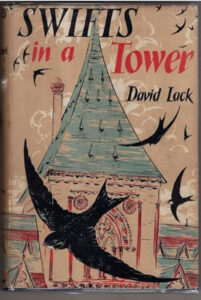
 Swifts in a Tower by David Lack
Review for Hexham Space 4 Nature by Matthew Greening
Visit any bookshop (including Hexham’s wonderful Cogito books) and you will be struck by the ever-expanding shelf space taken up by nature writing. At a time when human impact on the planet is leading to a dramatic loss of biodiversity, readers seem to be seeking greater connectivity with the natural world through literature.
What is it we are looking for in all those books on orchids and orangutans, fish and fungi? As we scan the shelves it may be tempting to think that the latest publications will offer the greatest insight. Surely in the world of camera traps, DNA analysis and GPS tracking we must be getting ever better information? The subject of this review, ‘Swifts in a Tower’, may show you that is not always the case.
First published in 1956, Swifts in a Tower describes the research on the lives of swifts nesting in the tower of what was originally Oxford University Museum of Science and is now the Museum of Natural History. Swifts had started to nest in the tower many years before the research started in 1948.
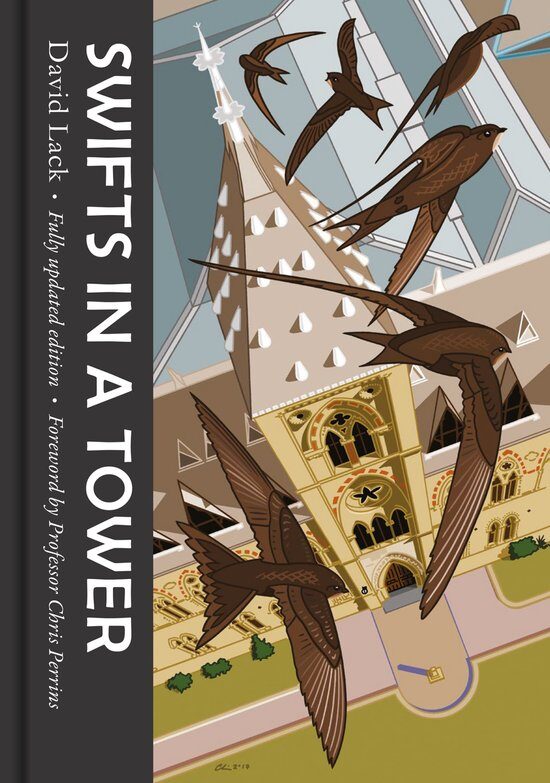 That research continues to this day and this edition from 2018 has been updated with the addition of a new chapter by the author’s son, Andrew Lack, bringing us right up to date.
The book tells the story of swifts and their extraordinary lives. Readers will learn about how they nest in holes high up in buildings, replicating their original nests sites in trees. Swifts are dedicated to the same nest sites every year where they rear 2 or 3 young. These are truly wonders of the arial world. Lack tells us how a young bird may leave the nest in August and not touch down again for 3 years, eating, sleeping and eventually mating on the wing.
In 1948 and onwards this knowledge was obtained by dedicated observation. You will discover how the team at Oxford adapted existing nesting sites in the tower creating nest boxes with glass backs at which observers would sit for countless hours. They recorded everything which happened in the nests including courtship, nesting, egg laying, feeding and fledging.
We go beyond the tower at Oxford to include what was known at the time about the bird’s flying abilities, their movements in response to weather patterns and their annual migration to Africa.
The 1950’s writing style is still very accessible today. This is not an academic book but one packed with easy-to-read detail about all things ‘swift’. You can share the author’s enthusiasm and wonder for these extraordinary and enigmatic birds.
If there is an area where changes since publication become apparent then it’s in some of the survey methodologies of the times. In the 1950s, before the legal protections which are now in place, it was still a scientific practice to kill for the purpose of research. It’s clear this was done by the team at Oxford, for example to investigate what prey species the birds were taking to feed their young.
But let’s not judge harshly. Who are we to condemn when human actions since this book was written have done so much to ‘kill’ countless numbers of birds. Just since 1995 swift numbers in the UK have declined by 62% mainly through loss of nesting sites, fewer insects to feed on and climate change. The loss of a few birds has led to so much learning which still informs swift conservation measures carried out today.
Can we use the knowledge gained by David Lack, and his colleagues, with what we have learnt since, and allow ourselves, as they did, to wonder at the mystery and magic of this special bird? If so, then perhaps we can hope that in another 62 years there will be the next update in this extraordinary story of ‘Swifts in a Tower’. Will it be a printed version on the packed shelves of the natural history section at Cogito? Only time will tell.
Swifts in a Tower by David Lack
Published by Unicorn
ISBN 978-1-911604-36-5